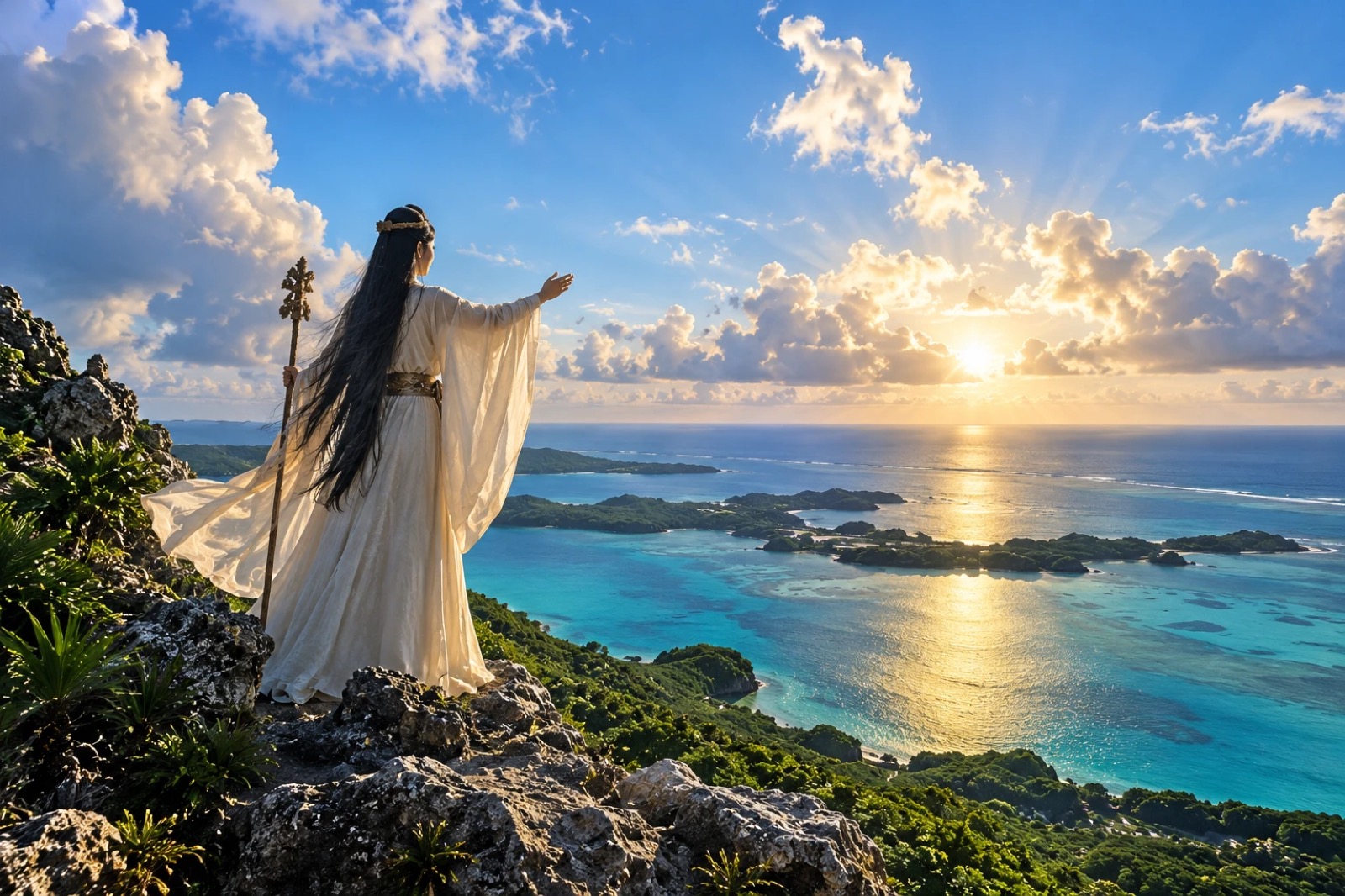
Seven utaki said to have first been made by Amamikiyo, the creator god of Ryukyu. Not places to view — places to pray. Please learn what is being prayed to before you go.
Nanjo lies on the east (agari) side of Okinawa Island — the direction the sun rises.
That is why the pilgrimage route through this area has long been called Agari-umai. Here, morning light is not scenery. It is a time for prayer.
Illustrative imageGenerated by AI. Not a record of any real person, place, or event. Will be replaced with an on-site photograph.
THE SEVEN
The Seven Utaki
The black label marks Nanjo. Four of the seven have full articles.
Taking photos is not forbidden. But there are places you should not photograph.
Fine to photograph
The approach, entrance, and signage
The wider landscape, from a distance
Your own group (where no one else is in frame)
Please don't
Anyone praying. Not even from behind
The incense burner and offerings
Beyond any no-entry sign. Inside Sanguui at Sefa-utaki, or inside Fubo-utaki
Drones
If in doubt, don't take the photo. You lose nothing by not taking it.
This site plans to use photos shared by residents and visitors. How to submit one is still being worked out.
Manners for visiting
There is one thing to keep in mind: someone may be praying here today, just as they were yesterday.
Please do
Bow once at the entrance
Wait if someone is praying
Keep your voice low. Don't run
Wear walkable shoes and modest clothing
Please don't
Take stones, sand, or plants home
Stand in front of the place of prayer to photograph it
Touch the incense burner or offerings
Go beyond a no-entry sign
If you're unsure of the manners, simply pressing your hands together, without leaving anything, is enough.
Utoushi (praying from afar)
Okinawa has a formal way to pray without entering a place: facing its direction from where you stand. This is called utoushi.
Fubo-utaki (Kudaka Island) is closed to entry, always. But this isn't "you can't go" — not entering is the act of prayer there. You press your hands together just before the sign.
A utaki has no shrine building and no statue. What is prayed to is the innermost sacred spot, called the ibi — marked only by an incense burner, and beyond it, a sacred tree (kuba).
No one goes past the incense burner to the ibi. You pray from in front of it.
Without knowing this, it just looks like a forest or a rock. Knowing it, it looks like something else entirely.
HOW LONG DO YOU HAVE
How much time do you have today?
Nanjo is not a place to rush through.
What you have time for changes what you'll see.